Design for manufacturability (DFM) is the practice of designing components so they can be produced efficiently, reliably, and at a predictable cost. While many designs may look correct in CAD, manufacturing constraints often reveal hidden challenges once production begins.
Manufacturers frequently receive design files that require clarification, redesign, or engineering adjustments before production can begin. These issues introduce delays, increase quoting complexity, and often raise the final cost of the part.
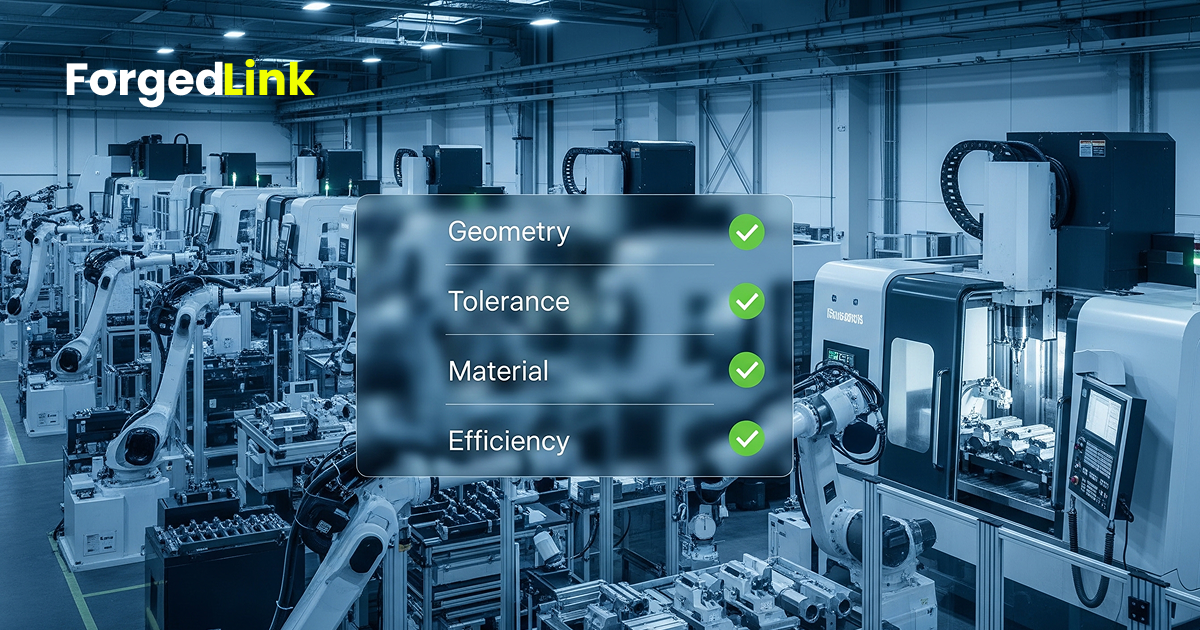
Applying a simple manufacturability checklist before submitting a part for production can prevent many of these problems. By reviewing geometry, tolerances, materials, and manufacturing requirements early, engineers can significantly improve production readiness.
1. Geometry Validation
The first step in any manufacturability review is validating whether the geometry of the part can realistically be produced using the intended manufacturing method.
Different processes impose different geometric constraints. CNC machining requires tool access, while additive manufacturing introduces rules related to support structures and overhang angles.
Engineers should review the following questions:
- Are wall thicknesses compatible with the chosen manufacturing process?
- Are internal features accessible for cutting tools?
- Are deep cavities or narrow pockets likely to cause machining difficulty?
- For additive manufacturing, are overhangs properly supported?
- Does the part require excessive machining depth or specialised tooling?
Addressing these issues early prevents costly redesigns later in the production process.
2. Tolerance Review
Tolerances define how precisely a part must be manufactured. While tight tolerances may be necessary for critical features, unnecessarily strict tolerances can dramatically increase manufacturing cost.
Every manufacturing process has practical limits for dimensional accuracy. Specifying tolerances beyond these limits may require additional machining operations, specialised tooling, or post-processing steps.
Before submitting a design for production, engineers should verify:
- Are tight tolerances limited only to functional surfaces?
- Are standard tolerances sufficient for non-critical features?
- Can the selected manufacturing process achieve the specified tolerance?
- Are tolerances clearly defined on technical drawings?
Reducing unnecessary precision requirements often results in faster manufacturing and lower production costs.
3. Material Compatibility
Material selection should align with both performance requirements and manufacturing capabilities. Some materials machine easily, while others introduce challenges such as increased tool wear, slower cutting speeds, or complex heat treatment requirements.
Similarly, additive manufacturing processes rely on specific powder-based materials that behave predictably during laser fusion.
Before sending a design for production, engineers should consider:
- Is the selected material compatible with the intended process?
- Will the material require additional heat treatment or finishing?
- Is the material readily available from suppliers?
- Does the material significantly increase machining difficulty?
Choosing a material that balances performance with manufacturability helps prevent production delays and excessive costs.
4. Manufacturing Efficiency
Manufacturability is not only about whether a part can be produced, but also how efficiently it can be manufactured. Parts that require numerous setups, specialised fixtures, or complex machining strategies will inevitably increase production cost.
Engineers should evaluate whether the design can be simplified without compromising performance.
- Can features be simplified to reduce machining operations?
- Are unnecessary geometric details increasing complexity?
- Does the design require multiple setups to machine?
- Could the part be redesigned to improve tool access?
Even small design adjustments can significantly improve manufacturing efficiency.
5. Surface Finishing Requirements
Surface finish is another important consideration when preparing a design for production. Different manufacturing processes produce different surface qualities, and additional finishing operations may be required to achieve the desired appearance or functionality.
Common finishing processes include:
- Bead blasting
- Anodising
- Powder coating
- Electropolishing
- Heat treatment
Understanding these requirements early ensures that finishing processes are properly planned and included in the manufacturing workflow.
6. Supplier Readiness
Even a well-designed part can be difficult to manufacture if the information provided to suppliers is incomplete. Clear communication is essential for accurate quoting and efficient production planning.
Before submitting a part for quotation, engineers should confirm that all technical documentation is available.
- Complete 3D CAD model
- Technical drawings with tolerances
- Material specifications
- Surface finish requirements
- Quantity and production timeline
Providing clear information allows manufacturers to evaluate manufacturability quickly and generate accurate quotes.
Why Pre-Production Validation Matters
Many manufacturing delays occur because a design is submitted without proper validation. Engineers may assume a part is ready for production, only to discover later that it requires modifications.
By applying a structured manufacturability review before requesting quotes, organisations can significantly reduce engineering back-and-forth, improve supplier communication, and accelerate production timelines.
In practice, the most efficient manufacturing workflows begin with a pre-build validation step that confirms the design is ready for production.
Conclusion
Design for manufacturability is not a single decision but a systematic review of geometry, materials, tolerances, and production requirements. Applying a simple checklist before sending a design for manufacturing helps engineers identify potential issues early in the process.
By validating manufacturability before requesting quotes, companies can reduce production delays, improve supplier collaboration, and ensure that designs move smoothly from concept to production.
CTA: Validate your part’s manufacturability before sending it for production.