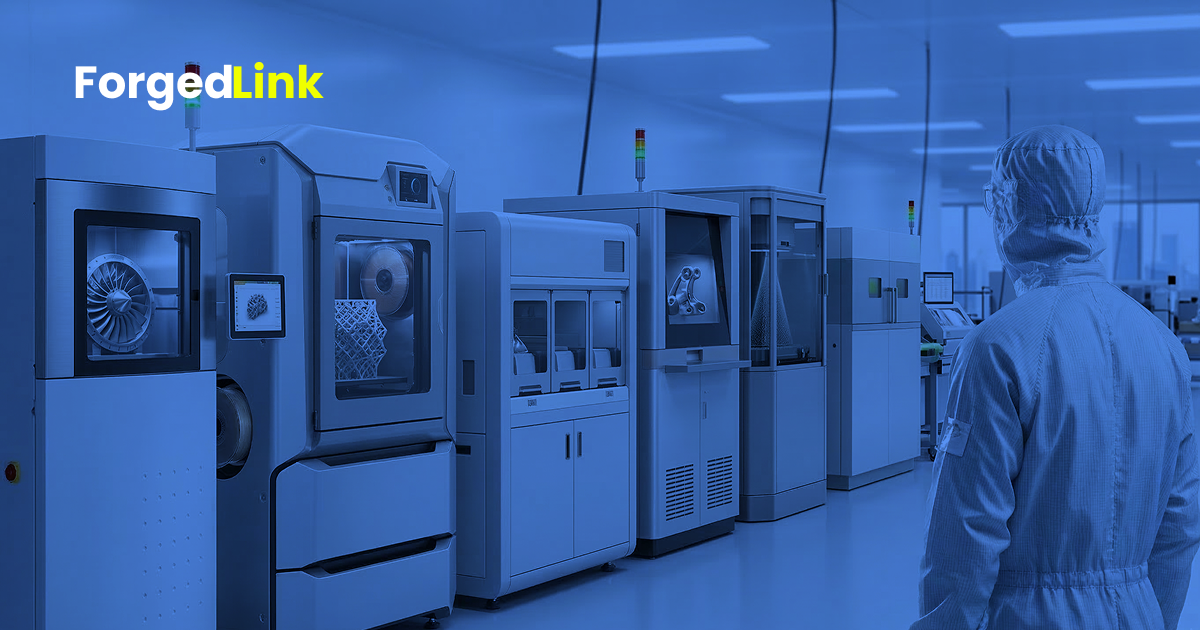
I often start conversations with providers by asking a simple question:
“What machines are you running?”
The answer usually arrives quickly. Sometimes proudly.
- EOS
- Nikon SLM
- Stratasys
- 3D Systems
- Desktop Metal
- Carbon
Build volumes. Laser counts. Material compatibility. New installations arriving next quarter.
None of this is unimportant.
But something interesting has happened in additive manufacturing over the past decade.
Equipment lists used to be a differentiator.
Today they are mostly a table stake.
Across polymers, metals, composites and binder jetting, the core technologies have matured significantly. The industry has scaled. Capital has flowed. Providers have invested.
It is no longer unusual for two competing service providers — even in different countries — to operate nearly identical hardware.
- Same machines
- Same materials
- Similar parameter sets
Yet their outcomes can look very different.
- Lead times vary
- Margins fluctuate
- Customer retention diverges
Which raises an uncomfortable question:
If everyone has similar equipment… what actually differentiates providers now?
The answer, increasingly, is execution.
But before we get there, it’s worth acknowledging why equipment lists remain such a powerful signal in the market.
Buyers understandably look for tangible indicators of capability.
A machine is easy to understand. It has a brand, a model number, and published specifications.
It provides a visible shorthand for competence.
But machines alone tell you very little about how a provider actually operates.
Owning a system does not automatically imply:
- Predictable build success
- Stable process control
- Integrated post-processing
- Disciplined quality assurance
- Repeatable economic outcomes
The machine is the starting point of the process.
Not the system itself.
This creates an interesting distortion in how the market evaluates providers.
Equipment lists are often treated as the primary evidence of capability.
Yet many of the most important factors influencing delivery happen outside the machine entirely.
- Post-processing alignment
- Process stability across batches
- Inspection discipline
- Material handling consistency
- Parameter drift management
These are less visible than a machine purchase.
But they matter far more over time.
Two providers might run identical hardware and produce very different reliability profiles.
One may treat production as a tightly controlled statistical system.
The other may rely on the experience of individual operators and troubleshooting under pressure.
Both may technically “have the machine.”
Only one consistently delivers predictable output.
This is where execution architecture becomes the real differentiator.
Execution architecture isn’t a single capability.
It’s the system surrounding production.
How builds are qualified:
- How parameters are maintained
- How variation is detected early
- How finishing steps are integrated
- How inspection data feeds back into future builds
When these elements are aligned, additive becomes repeatable.
When they are not, the process becomes fragile.
The industry sometimes underestimates how subtle these differences can be.
From the outside, two providers might appear nearly identical.
- Same equipment
- Similar material portfolios
- Comparable capacity
But inside their operations, the discipline of execution can differ dramatically.
One provider tracks drift across dozens of builds and adjusts proactively.
Another discovers variation only after a part fails inspection.
One integrates finishing as a coordinated step within production planning.
Another treats it as a downstream bottleneck that absorbs surprises.
These differences rarely appear in marketing material.
Yet they are exactly what determine whether additive works reliably in production environments.
This shift — from machine differentiation to execution differentiation — is typical of maturing technologies.
Early in a technology cycle, access to hardware creates advantage.
Later, advantage shifts toward those who operate the technology more effectively.
We’ve seen this pattern in many industries.
- Cloud computing eventually stopped being about who owned servers
- Semiconductor fabrication eventually stopped being about who owned lithography equipment
Over time, operational discipline becomes the moat.
Additive manufacturing is moving through a similar transition.
The question is no longer simply:
“Who has the machine?”
The more interesting question is:
“Who has the system around the machine?”
Because machines print geometry.
Systems produce outcomes.
Providers who recognize this shift early will likely position themselves differently.
Instead of emphasizing equipment acquisition alone, they will emphasize operational architecture.
- Process transparency
- Repeatability metrics
- Execution reliability
Not because machines are irrelevant.
But because machines are no longer rare.
In a market where hardware is increasingly accessible, differentiation naturally migrates elsewhere.
Toward how consistently the technology is applied.
And perhaps the industry is only beginning to appreciate how significant that shift really is.