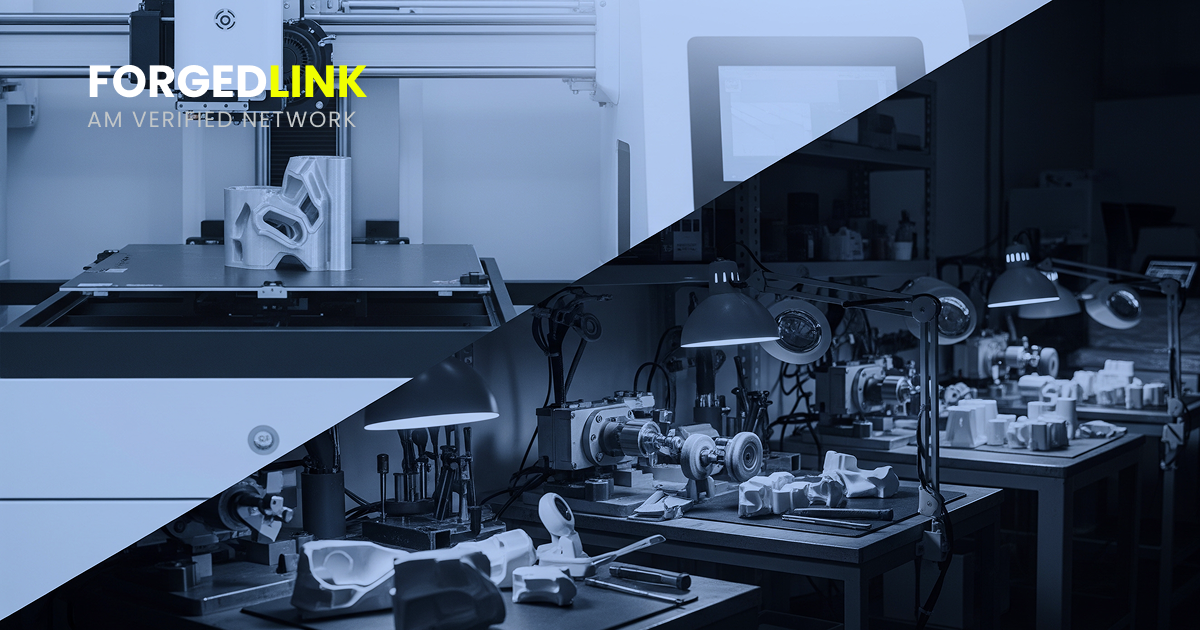
In additive manufacturing conversations, the printer usually occupies center stage.
Build speeds. Laser counts. Layer thickness. Material compatibility.
These specifications are easy to discuss and easy to compare. They also shape how many people evaluate capability in additive manufacturing.
But there is a persistent blind spot in these discussions.
Most of the work happens after the print.
The Part Is Only Halfway Done
When a build completes, it is tempting to treat that moment as the end of the production process. In reality, it is closer to the midpoint.
A printed component typically enters a sequence of additional steps before it becomes a usable production part.
- Powder removal or unpacking
- Support removal
- Heat treatment or stress relief
- Surface finishing
- Machining or secondary processing
- Inspection and validation
Each of these steps introduces its own constraints, lead times, and risks. The machine may produce complex geometry with impressive precision, but that geometry must still travel through the rest of the workflow.
If any stage slows down, the entire production chain slows with it.
Why Post-Processing Gets Overlooked
There are a few reasons post-processing often receives less attention.
First, it is less visible. A printer is a large, identifiable piece of equipment. Post-processing is distributed across multiple tools, stations, and manual processes.
Second, post-processing varies widely between parts. Two components printed on the same machine may require very different finishing pathways depending on their material, geometry, and tolerance requirements.
Finally, post-processing does not carry the same technological narrative as printing itself. Printers represent innovation. Finishing steps often look like traditional manufacturing.
Yet operationally, finishing is where much of the real complexity resides.
The Hidden Capacity Constraint
Many additive operations discover that their printers are not the primary constraint.
The constraint sits downstream.
- Support removal takes longer than expected
- Heat treatment capacity becomes limited
- Surface finishing queues begin to form
- Inspection cycles delay delivery
When this happens, machines may remain busy while finished parts accumulate slowly. The shop floor looks active, but the flow of completed parts tells a different story.
Post-processing quietly determines throughput.
The Cost That Appears Later
The blind spot is not only operational. It is economic as well.
Printing costs are usually estimated with relative precision. Machine time, material consumption, and energy use can be calculated with reasonable accuracy.
Finishing costs are harder to predict.
- Manual labor requirements vary
- Complex geometries increase support removal time
- Surface quality targets drive additional processing
- Inspection requirements introduce further steps
What appears to be an efficient print job can evolve into a far more expensive finishing process.
In some cases, the majority of production cost emerges after the machine stops running.
The Flow Problem
Post-processing also shapes how smoothly parts move through the production system.
When printing capacity expands faster than finishing capacity, imbalance emerges.
- Builds complete faster than they can be unpacked
- Parts wait for heat treatment availability
- Finishing teams struggle to keep pace with production
- Inspection becomes a bottleneck before delivery
This imbalance creates queues between stages.
Lead times increase even though the printer itself performs exactly as expected.
The result is a familiar pattern: high utilisation, but modest throughput.
Design Decisions Amplify the Effect
Another factor often overlooked is the relationship between design and finishing effort.
Additive design frequently emphasises geometric freedom.
But geometry that is easy to print is not always easy to finish.
- Internal channels complicate powder removal
- Dense support structures increase removal time
- Complex surfaces require additional finishing steps
- Tight tolerances introduce secondary machining
Design decisions made early in the process can significantly influence the workload that appears later.
This is why finishing is not merely a downstream activity. It is part of the production system from the beginning.
Thinking Beyond the Printer
As additive manufacturing moves from prototyping into production, this blind spot becomes more consequential.
Hardware capability across the industry has improved substantially. Many providers now operate similar equipment with comparable technical specifications.
The difference increasingly appears elsewhere.
- How post-processing capacity is planned
- How finishing steps are integrated with production scheduling
- How inspection workflows align with throughput targets
- How design decisions account for downstream effort
Operations that treat printing as the central event often struggle with unpredictable delivery timelines.
Operations that treat finishing as part of a coordinated system tend to achieve more consistent results.
The Real Production System
Additive manufacturing does not end when a part leaves the machine.
It ends when a finished, inspected component reaches the customer.
Everything in between determines whether production works reliably.
The printer is a critical step. But it is only one step.
And until the industry treats post-processing as an equal part of the production architecture, the blind spot will remain.