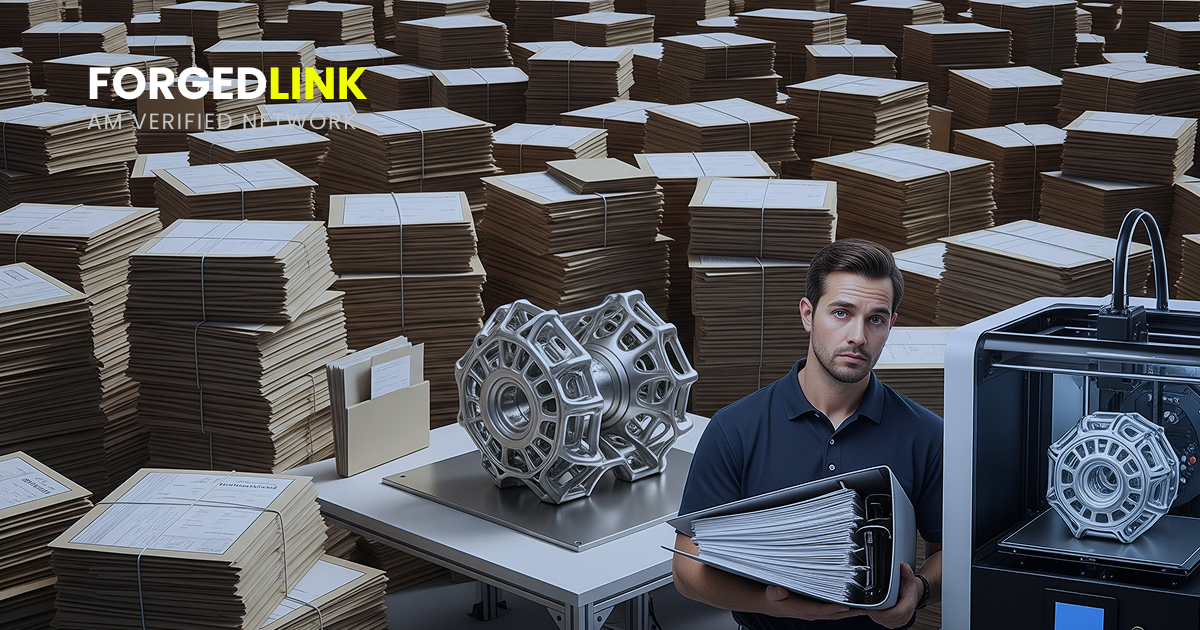
Qualification is often treated as a necessary hurdle in additive manufacturing.
Customers require verification. Suppliers provide documentation. Parts move through testing, inspection, and approval before entering production.
In regulated industries this process is expected. Aerospace, medical, and energy sectors all demand rigorous validation before new manufacturing methods are adopted.
Yet across the additive manufacturing ecosystem, a pattern has emerged that many providers quietly recognise.
The industry is experiencing qualification fatigue.
The Repetition Problem
In theory, qualification ensures reliability and traceability. In practice, it often becomes a repetitive process that is repeated again and again across organisations.
A provider may demonstrate capability once, but the verification rarely travels with them. Instead, the same process must be repeated for each new customer.
- Supplier capability assessments
- Machine validation and documentation
- Material traceability reviews
- Process audits and quality system checks
- Test builds and inspection trials
None of these steps are unnecessary. Each plays a role in building confidence.
The problem is that they are frequently duplicated rather than shared.
The Cost of Requalification
For additive providers, qualification cycles consume significant operational energy.
Engineering teams prepare documentation, run test builds, and respond to audit requests. Quality departments compile traceability records and maintain compliance frameworks.
Meanwhile, production teams continue managing ongoing work.
The effort required for qualification often includes:
- Engineering time for process validation
- Material and machine capacity dedicated to test builds
- Quality assurance documentation and reporting
- External audits and customer-specific reviews
Each individual exercise may appear manageable. But when multiplied across customers, the burden grows quickly.
What was intended to ensure reliability begins to create friction.
The Hidden Operational Effect
Qualification fatigue does not only affect administrative workload. It also influences how additive providers allocate their technical resources.
Highly skilled engineers may spend substantial time repeating validation work rather than improving production processes.
Machines may run test builds instead of revenue-generating production.
Quality teams may spend more time responding to audits than analysing performance data.
In isolation these trade-offs seem small. Across the entire ecosystem, they add up to a significant opportunity cost.
Why the Pattern Persists
Despite the inefficiency, the cycle continues for understandable reasons.
Customers need assurance that parts will perform as expected. Certification frameworks exist to reduce risk, especially in high-consequence applications.
But additive manufacturing introduces a unique complication.
The technology sits at the intersection of multiple variables:
- Machine configuration
- Material behaviour
- Process parameters
- Post-processing conditions
Because outcomes depend on how these variables interact, organisations often prefer to run their own validation rather than rely on external certification.
The result is a fragmented qualification landscape.
The Structural Nature of the Problem
This is why qualification fatigue is best understood as a structural issue rather than an operational one.
The additive ecosystem lacks a widely trusted framework that allows validated capability to travel between organisations.
Instead, trust is rebuilt repeatedly through individual qualification cycles.
Every new relationship effectively starts from the beginning.
From the customer’s perspective, this reduces risk.
From the supplier’s perspective, it creates duplication.
The Market-Level Consequence
When repeated across hundreds of providers and thousands of parts, the system produces several broader effects.
- Slower adoption of additive manufacturing in production
- Higher operational overhead for service providers
- Reduced capacity for process improvement and innovation
- Longer timelines between design and industrialisation
None of these outcomes are intentional. They emerge from the way trust is currently constructed within the market.
Moving Toward Transferable Trust
If additive manufacturing continues to mature as a production technology, the ecosystem may eventually move toward more transferable forms of validation.
Not necessarily universal certification, but mechanisms that allow verified capability to carry weight beyond a single customer relationship.
Possible approaches could include:
- Shared process qualification frameworks
- Transparent capability benchmarking
- Independent verification bodies recognised across industries
- Standardised documentation structures for process validation
These mechanisms would not eliminate qualification entirely. Nor should they.
But they could reduce the need to restart the process from scratch each time a new partnership begins.
A Signal of Maturity
Every emerging technology goes through a period where trust must be built slowly.
Additive manufacturing is still navigating that phase.
The persistence of qualification fatigue may actually signal something important: the industry has moved beyond experimentation and into a stage where production credibility matters deeply.
The challenge now is ensuring that the systems used to establish trust do not unintentionally slow the ecosystem that depends on them.
Because in the long run, the goal of qualification is not simply verification.
It is enabling reliable production at scale.