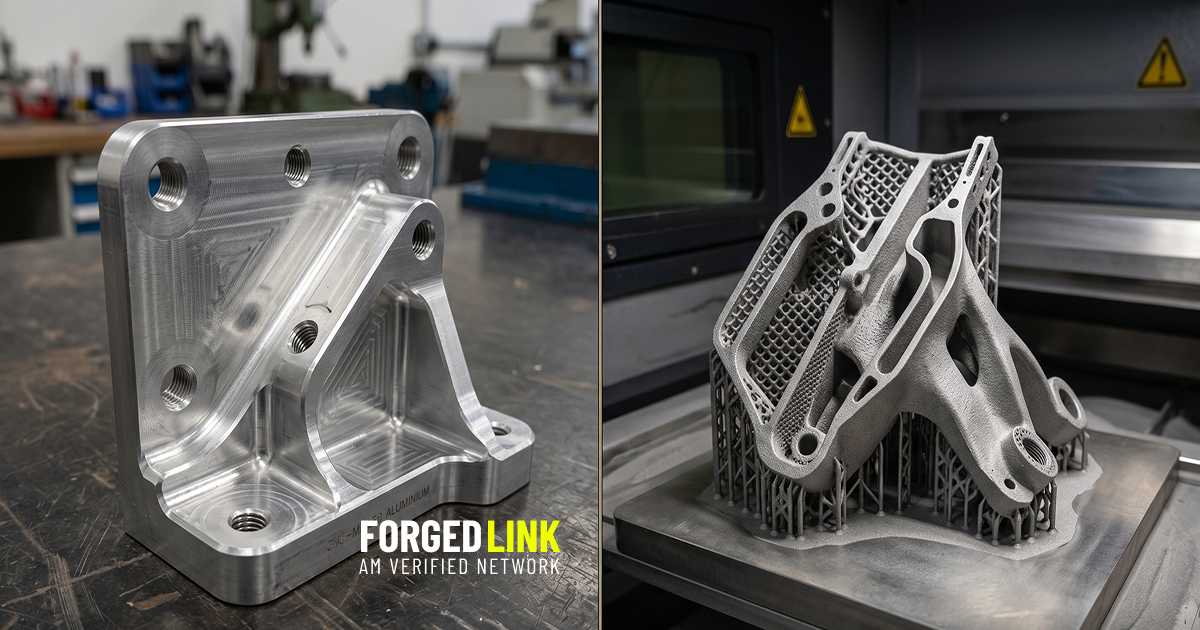
The short answer
CNC machining wins on cost, accuracy, and lead time for prismatic parts in common materials. Metal 3D printing — typically laser powder bed fusion (LPBF) — wins when geometry is impossible to machine, when part consolidation eliminates joints, or when weight reduction matters more than unit cost.
That covers most cases. The interesting decisions are at the boundary: low volumes, awkward geometry, or where the part could be designed for either. The rest of this article is about how to make those calls without guessing.
Head-to-head on the five dimensions that matter
| Dimension | CNC Machining | Metal 3D Printing (LPBF) |
|---|---|---|
| Geometry | Prismatic, rotational, pocketed, threaded. Internal features limited to what a tool can reach. | Internal channels, lattice, conformal cooling, organic / topology-optimised shapes, consolidated assemblies. |
| Tolerance (as-built) | ±0.025 mm routine, ±0.005 mm on precision work. | ±0.1–0.2 mm typical. Critical surfaces are usually machined post-print. |
| Surface finish (as-built) | Ra 0.8–3.2 typical. Polished or ground to Ra 0.1. | Ra 6–25 as-printed. Needs bead blast, machining, or polish for anything finer. |
| Material range | Almost any machinable metal — common alloys cheap and stocked. | Curated list — AlSi10Mg, Ti-6Al-4V, 316L, 17-4PH, Inconel 625/718, tool steels, a few others. Custom alloys rarely available. |
| Lead time (low volume) | 24 hours to 2 weeks depending on complexity and supplier queue. | 3–7 days build + 2–5 days post-processing. Queue dependent on machine availability. |
| Cost behaviour with volume | Drops with quantity — setup amortises, programming reused. | Roughly flat — build cost is the same per cubic centimetre of part regardless of order quantity. |
| Tolerance to design changes | Usually free — re-program the same machine. | Re-orient, re-support, re-print. A change late in the project is expensive. |
Where CNC wins decisively
- Prismatic mechanical parts in common materials. Brackets, plates, housings, fixtures, manifolds without internal channels. Aluminium 6061, stainless 304/316, mild steel. CNC is faster, cheaper, more accurate.
- Tight tolerance, polished surfaces. Anything that needs ±0.025 mm or better, or Ra below 0.8. CNC delivers this as-machined; metal AM gets there only with secondary machining — at which point you're paying for both processes.
- Threaded features and bearing fits. Tapped threads, reamed holes, ground bearing journals. All routine on CNC. All require post-machining on AM.
- Volume 100–10,000. Setup cost amortises. By the time you're at quantity 500, CNC unit cost has dropped 40–60% from the prototype price; AM unit cost is essentially flat.
- Time-critical short runs. A simple machined bracket can be quoted, programmed, and delivered in 24 hours from a shop with capacity. AM build slots are typically 3–7 days out.
- Parts that will change. If the design is still moving, every print iteration is a setup. Every machined iteration is a re-program.
Where metal 3D printing wins decisively
- Internal channels and conformal cooling. A heat exchanger, a hydraulic manifold with optimised flow paths, a tool-steel insert with cooling lines that follow the cavity surface. Impossible or impractical to machine. Routine in LPBF.
- Topology-optimised, weight-critical parts. Aerospace brackets, motorsport components, prosthetics. Where every gram matters and the optimised shape can't be machined economically.
- Part consolidation. Replacing a 12-piece welded assembly with a single printed component. The cost saving isn't just the parts — it's the elimination of joints, fasteners, alignment, and inspection.
- Geometry that isn't accessible to a tool. Hollow internal lattices, undercuts inside cavities, channels that turn 90°. Some of these are technically machinable with EDM, but at orders of magnitude more cost.
- Volume of 1–50 with complex geometry. Low enough that tooling for any other process doesn't pay back, complex enough that machining setup / fixturing per part is prohibitive.
- Custom one-offs in exotic materials. Patient-specific implants in titanium, repair parts in Inconel for legacy equipment, ducts for unique aerospace assemblies.
Where the answer is "it depends"
These are the cases where engineers actually have a choice. The decision triggers come down to specifics:
Low-volume titanium parts (qty 1–20)
CNC machining titanium is expensive — slow speeds, high tool wear, and most of the bar stock ends up as chips. LPBF in Ti-6Al-4V uses powder efficiently and is often cheaper at low volume despite the per-cubic-cm build cost. The crossover depends on geometry: simple prismatic titanium parts still favour CNC; anything with weight-optimised features or complex internal geometry favours LPBF.
Tooling inserts with cooling
A traditional injection mould insert with drilled-and-plugged cooling lines vs an LPBF insert with conformal cooling channels. The LPBF insert costs 2–4× the conventional one. It also reduces cycle time by 15–40% in the moulding press. For high-volume production tooling, the conformal cooling pays back in months. For a low-volume prototype tool, conventional wins.
Aerospace brackets in qty 1–10
The geometry is usually optimisable for AM (weight-critical, complex). The qualification cost is the killer — qualifying a new metal AM part for flight is significantly more expensive than qualifying a machined equivalent. For an unqualified prototype, AM is often the right call. For a qualified production part, machining is usually the safer call unless the weight saving justifies the qualification programme.
Functional prototype that becomes a production part
This is where engineers most often regret the choice. Printing a metal prototype because "we'll figure out production later" sometimes works — but more often the production process needs different geometry, different tolerances, different finishing. Decide the production process first, prototype with a method that mirrors its constraints. The Process Selection framework covers this in detail.
Part with mixed features — some prismatic, some complex
Hybrid manufacturing is increasingly viable — a near-net DED or LPBF preform finished on a 5-axis machine. For very complex parts where CNC alone can't deliver the geometry and AM alone can't deliver the surfaces, hybrid is often the right answer. It's also the most expensive route, so use it only when the part actually needs it.
The cost crossover that surprises most engineers
The intuition is "AM is cheaper for low volume, CNC takes over at higher volume." Reality is more compressed than that:
- For simple geometry, CNC is cheaper from quantity 1. The setup cost is small enough that even one-off prototypes go to a 3-axis mill.
- For moderately complex geometry, AM is competitive at quantity 1–10 and CNC takes over by quantity 20–50.
- For highly complex geometry with internal features, AM stays cheaper across most volumes — sometimes the only viable option, period.
The crossover isn't a curve on a slide. It's specific to the part. The way to find it is to quote both processes at quantities of 1, 10, 50, and 250 — most suppliers will give you that range on a single RFQ.
If-X-then-Y: decision triggers
- If the part has internal channels, conformal cooling, or lattice → metal AM. CNC can't reach the geometry.
- If the part is prismatic with tight tolerances and the material is common → CNC. Faster, cheaper, more accurate as-built.
- If volume is 100+ and the geometry is machinable → CNC. Setup amortises; AM cost stays flat.
- If the design is still iterating → CNC. Each change is a re-program; each AM change is a re-print.
- If lead time is <3 days for a single part → CNC if a shop has capacity; AM build slots are usually 3+ days out.
- If the part needs Ra better than 1.6 or tolerances tighter than ±0.05 mm → CNC, or AM with critical surfaces machined post-print (in which case CNC is usually still cheaper).
- If the part is weight-critical and topology-optimised → AM. The optimised shape isn't machinable economically.
- If a 12-piece welded assembly could be one consolidated part → AM. Joint elimination usually pays for the print cost.
Common mistakes that make the choice harder
- Picking AM because the geometry "looks 3D-printable." Looking printable and being economically printable are different things. A simple bracket can be printed; it just shouldn't be.
- Picking CNC because "we've always done it that way." Holds back legitimate AM wins on internal-feature parts, conformal cooling tooling, weight-critical structures.
- Quoting only one supplier per process. CNC quotes vary 30–60% across suppliers; AM quotes vary even more depending on machine availability and powder stock.
- Comparing as-printed AM to as-machined CNC. If the AM part needs critical surfaces machined, the real comparison is AM-plus-machining vs CNC-only.
- Ignoring qualification cost. For regulated industries, qualifying a new AM part for production is months of work. The unit cost saving has to justify the qualification programme.
- Treating the prototype process as the production process. What's right for one part at quantity 1 is rarely right for the same part at quantity 500.
The right way to actually decide
Walk it backwards from production volume. At your real production quantity, which process is economically viable? That's your production answer. Then ask: does the prototype process need to mirror that, or can it diverge for speed?
For most engineering parts, the production answer is CNC. AM enters when the geometry, weight constraint, or part consolidation makes a compelling case that volumes can't override. The mistake is letting the prototype process choice constrain the production design — by then it's too late to change.