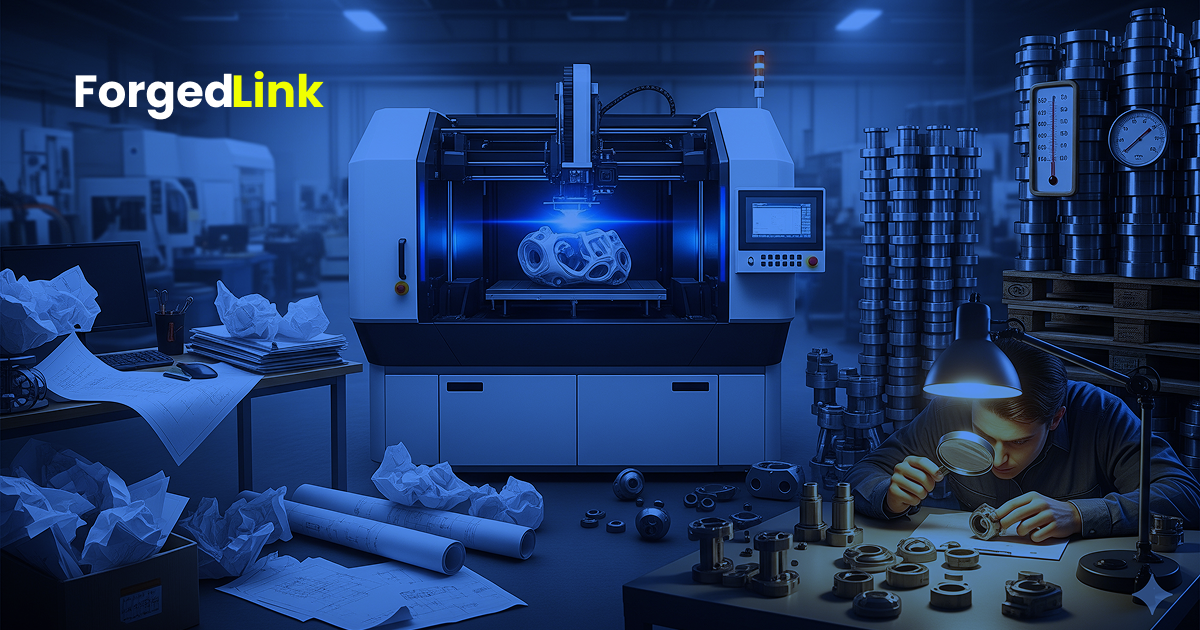
When a part fails in additive manufacturing, the instinct is often to blame the printer.
Too often, discussions focus exclusively on hardware:
- Laser power and energy delivery
- Build volume and geometry constraints
- Scan strategies and software settings
- Material compatibility and powder properties
But after years of observing production environments, a different pattern emerges. The machine is rarely the true point of failure. In fact, the most sophisticated hardware can still produce inconsistent outcomes if the system around it is poorly managed.
Where Failures Actually Happen
Failures usually appear in the interactions surrounding the printer, not within the printer itself. These are often overlooked because they are less visible than the machine’s specifications:
- Design handoffs that introduce small errors or inconsistencies
- Material preparation and handling inconsistencies
- Post-processing bottlenecks, such as support removal, curing, or heat treatment
- Inspection and validation gaps that fail to catch deviations early
- Scheduling misalignment, creating idle machines or rushed builds
- Communication breakdowns between teams or with customers
Each of these elements is part of the broader production system. A technically capable machine cannot compensate for breakdowns in workflow, coordination, or planning.
The Myth of Technical Limitation
It’s easy to assume that adding more sophisticated hardware or faster machines will solve production problems. In reality, this approach often addresses the wrong layer of the system. Technical limitations are a comforting scapegoat, but they rarely reflect the root cause.
Two providers can operate identical machines using the same materials and parameters. One delivers consistently high-quality parts, with predictable lead times. The other experiences repeated defects, delayed builds, and unexpected rework.
Why? Because the difference is rarely in the printer itself. It is in the system around it — the invisible architecture of processes, workflows, and execution discipline.
Execution Architecture Determines Reliability
The success of additive manufacturing is determined by the structure surrounding the machine. Execution architecture encompasses how a provider manages the full lifecycle of a part:
- How build parameters are standardized, monitored, and adjusted
- How variation is detected and corrected before parts leave the machine
- How post-processing is scheduled, integrated, and executed efficiently
- How inspection and quality assurance feedback informs future builds
- How teams coordinate to align production capacity with demand
- How documentation and compliance are tracked for repeatable processes
Machines print geometry. Systems produce reliable outcomes. When these elements are aligned, additive operations become predictable. When they are fragmented, failures appear, even with the most advanced hardware.
The Illusion of Machine-Centric Performance
Many providers still rely on utilisation metrics to measure success. Machines are running? Productivity is high. Right?
Not necessarily. A machine can operate at high utilisation while overall production throughput stagnates:
- Post-processing queues back up, creating bottlenecks
- Inspection takes longer than anticipated, delaying delivery
- Parts wait in-between stages, increasing lead time
- Rework or corrections disrupt the schedule
High utilisation may signal activity, but it does not measure effective throughput — the number of fully finished, compliant parts delivered to the customer on time.
The Systemic Perspective
What additive manufacturing providers often underestimate is the systemic nature of production. Failures are rarely isolated; they compound across stages:
- A design flaw missed during handoff magnifies downstream errors
- Parameter drift in one build affects the reliability of the next
- Post-processing inefficiency delays the inspection process
- Inadequate communication results in misaligned expectations with customers
Viewed holistically, additive manufacturing is a chain of processes. Each link must be aligned. If one link is weak, the entire chain is compromised, regardless of the printer’s capabilities.
Shifting Focus from Hardware to Coordination
The industry is gradually recognising that machines alone are insufficient to guarantee production outcomes. Investment in new equipment may create confidence, but it does not resolve structural issues. The next phase of competitive advantage in additive manufacturing comes from aligning the system:
- Design handoff protocols that reduce errors
- Clear post-processing capacity planning
- Automated or disciplined inspection feedback loops
- Integrated scheduling that aligns production and demand
- Training and standardisation across operators
Machines are still crucial. They define what can be produced. But execution architecture defines whether it can be produced consistently and at scale.
Conclusion
Additive manufacturing does not fail at the machine. It fails where systems are incomplete, workflows are fragmented, and coordination is lacking.
Hardware is necessary, but it is not sufficient. Reliability, throughput, and quality are the product of well-engineered systems, not just well-engineered printers. As additive manufacturing moves from prototyping to production, recognising this distinction will separate the operators who succeed from those who struggle.