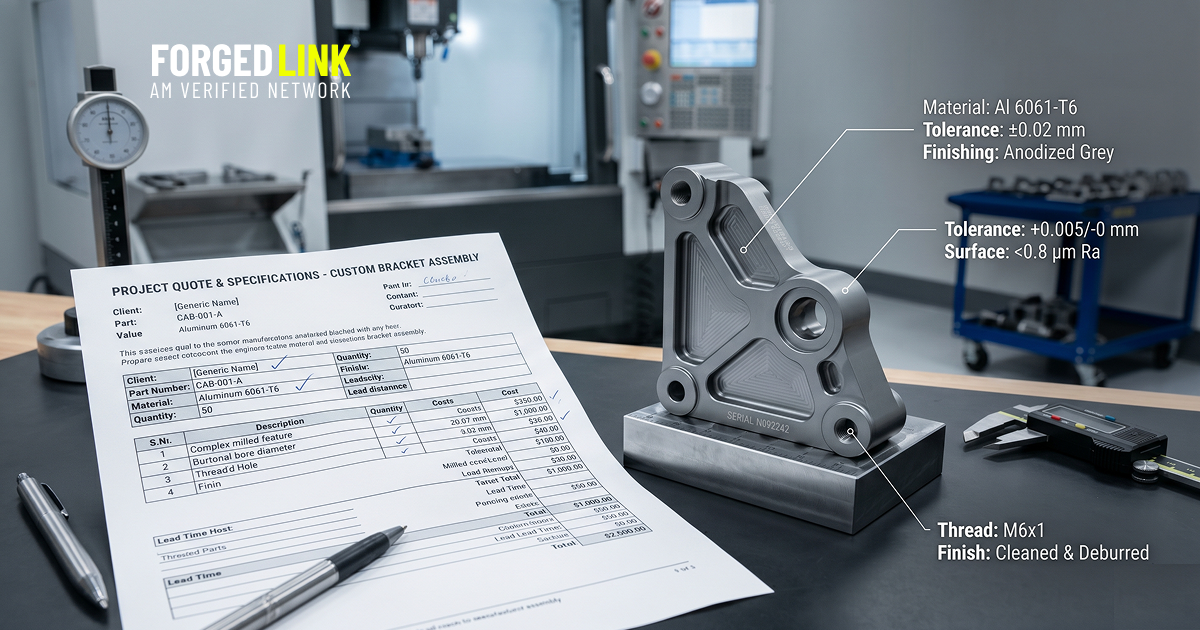
Why low-volume cost is fundamentally different
High-volume manufacturing is an optimisation problem: shave seconds off a cycle, save thousands of pounds. Low-volume is an amortisation problem: every setup, every fixture, every programming hour, every first-article inspection lands on the same small batch. The lever isn't speed per part — it's spreading fixed costs.
This is why "the same part" can quote at £85, £140, or £310 depending on the supplier. The variable cost of material and machine time is a fraction of the total. The rest is setup, programming, fixturing, inspection, finishing, and overhead — and how each supplier amortises those across their book.
Below are the eight levers that move that number. None of them require sacrificing quality. Most are decisions made before the RFQ goes out.
Lever 1: Drawing tolerances
The single biggest cost driver under your control is the tolerance specification on the drawing. Default tolerances should be the loosest your assembly tolerates, not the tightest your machine can hold.
- ±0.5 mm general: base cost.
- ±0.1 mm general: roughly 1.3–1.6× the base.
- ±0.025 mm on critical features: 2–3× — and inspection time multiplies, not just machining time.
- ±0.01 mm or below: grinding, lapping, or coordinate-measuring inspection enters the cost stack. Often 3–5× base.
What to do: mark the drawing with a default block tolerance (loose) and tighten only the features that drive function — bearing fits, sealing surfaces, mating interfaces. Everything else gets the default. Suppliers will quote dramatically lower when they're not running every feature to inspection-grade.
Lever 2: Geometry simplification
Most low-volume parts have features that exist because the original CAD geometry came from a different process or a different generation of the design. Each one has a cost. Examples:
- Internal corners with sharp radii on machined parts: require small tools, slow feeds, and often EDM. Adding a 1 mm fillet typically halves machining time.
- Counter-bores and counter-sinks not strictly needed for assembly: each is a separate tool change and operation.
- Cosmetic chamfers on every edge: a cycle-time tax. Specify only the chamfers that aid assembly, deburring, or finger safety.
- Pockets that could be through-holes: a pocket needs a flat bottom and a corner radius; a through-hole is one drill operation.
- Threaded blind holes when through-thread would do: drilling a relief at the bottom doubles the operation.
- Multiple datum surfaces requiring re-fixturing: each setup adds 30–60 minutes plus inspection.
For sheet metal: minimum bend radius matters, internal cut-outs near bends crack on form, and bend tolerance compounds. Each unnecessary bend is a station and a setup.
For additive: support material is part-cost. Re-orient the part to minimise overhangs, design self-supporting angles (typically 45° or steeper), and consolidate parts where possible to eliminate joints.
Lever 3: Material selection
Material cost is rarely the dominant unit cost in low-volume — but the wrong material choice quietly inflates everything else.
- Stainless 304 vs 316: 316 is ~30% more expensive in raw stock and machines slower. Specify 316 only when corrosion environment demands it.
- Aluminium 6061 vs 7075: 7075 costs more, machines fine, but is harder to anodise consistently. Worth the premium only when strength-to-weight is critical.
- Tool steel grades: A2, D2, H13, S7 all have different stock availability and lead times. Some grades require ordering bar stock that adds two weeks before machining starts.
- Engineering polymers: PEEK is 10× the cost of PA12 and machines slowly. Most parts can use a cheaper engineering polymer with similar mechanical properties.
- Custom alloys or rare grades: if the supplier doesn't stock it, you're paying for minimum-order purchase and waiting for delivery. Stick to common grades unless specifically required.
What to do: ask the supplier what they have in stock. A common grade that sits on their floor will quote faster and cheaper than a "better" grade that needs procurement.
Lever 4: Quantity batching
The "low volume" you're quoting now is rarely the final volume. Setup cost is amortised across the batch — so the unit cost curve is steep at low quantities and flattens fast.
Three common cases where batching wins:
- Forecasting demand for 12 months: producing 12 months in two batches of six months each is dramatically cheaper than 12 monthly batches. Storage cost is almost always less than re-setup cost.
- Combining variants: if you have three SKUs that share 80% of the geometry, ask the supplier to quote them as a single setup with variant-specific operations. Sometimes it doubles the run but cuts setup cost across all three.
- Combining customers / projects: within an org, multiple projects often need similar parts. Aggregating quantities across projects cuts unit cost on all of them.
What to do: always ask for quantity-break pricing on the RFQ — qty 50, 100, 250, 500. The breakpoint where the curve flattens tells you the right batch size for that supplier's setup costs.
Lever 5: Supplier selection
Two suppliers with the same machines will quote different prices for the same part. The difference is what's already on their floor.
- Capability fit: a 5-axis shop quoting a 3-axis part will be 30–60% more expensive than a dedicated 3-axis shop. The 5-axis machine costs more per hour to run.
- Spare capacity: a supplier with idle hours on the right machine will quote aggressively. A supplier running flat-out won't bother.
- Geographic match: shipping a heavy aluminium plate from a distant supplier eats the unit-cost saving. For dense or fragile parts, local wins on landed cost.
- Material stocked: if the supplier already has the bar/plate/sheet on the floor, you skip procurement lead time and procurement margin.
- Volume preference: some shops are built for prototypes (one-offs, fast turnaround, premium price); others for production runs (longer setup, lower unit cost, better at quantity 50–500). Match the shop to the volume.
What to do: get quotes from at least three suppliers whose declared capability and typical batch size matches your part. Avoid the temptation to quote everywhere — high-volume shops will price low-volume work to deter you, prototype shops will price production work to compensate.
Lever 6: Finishing scope
Finishing is where the quote and the invoice diverge most. A "raw machined" part is a fraction of the cost of the same part anodised, masked, and inspected. Be deliberate about what's in scope.
- As-machined vs deburred: deburring adds time. If the part isn't user-touching and isn't an assembly hazard, raw edges are fine.
- Bead-blast / brush vs polish: orders of magnitude apart. Polish only for sealing surfaces or cosmetic visibility.
- Anodising / plating: minimum charges apply — small batches sometimes pay the same as larger ones. Ask for a quantity-break on coating cost separately.
- Selective coating with masking: masking is often more expensive than the coating itself. Design parts so coating areas are entire faces or full coverage.
- Inspection requirements: first-article inspection (FAI), CMM reports, certificates of conformity — each adds cost. Specify only what the assembly genuinely requires.
For additive parts, finishing is usually 30–60% of total part cost: support removal, bead blast, machined critical surfaces, optional polish or coating. Quote the finished spec, not just the printed part.
Lever 7: RFQ quality
An ambiguous RFQ pads the quote. Suppliers add risk premium for everything they have to assume. Tightening the RFQ tightens the price.
What to include:
- 3D model (STEP or Parasolid) and a 2D drawing with critical dimensions.
- Material grade and any acceptable substitutes.
- Tolerance block (general) plus called-out tolerances on critical features.
- Surface finish requirements (Ra values where they matter, "as-machined" elsewhere).
- Quantity bands (50, 100, 250, 500) — not a single number.
- Required lead time and the cost of expediting if any.
- Finishing requirements: coating, marking, inspection.
- Packaging requirements: bulk, individual, kitted.
- Shipping destination and Incoterms.
What to leave out: assumptions you'd like the supplier to make. If you don't specify, they will — usually conservatively, and the price will reflect that.
Lever 8: Lead time
Lead time is a cost negotiation, not a fixed quantity.
- Standard lead time: the price you see in most quotes assumes the supplier can schedule the work in their normal queue.
- Expedited: typically 25–50% more for half the lead time. Sometimes worth it for production starts; almost never worth it for regular re-orders.
- Extended: if you can wait, ask. A supplier with a 6-week queue will sometimes drop 10–15% if you're flexible on slot.
- Forecast commitment: committing to repeat orders unlocks better pricing because the supplier can plan around your demand.
The mistake is treating the supplier's first quoted lead time as fixed. It's almost never the cheapest option — it's the safest one for them.
If-X-then-Y: when each lever pays back
- If unit cost is >3× material cost → tolerance and finishing are likely the inflators. Audit the drawing first.
- If quote varies >40% across suppliers → the part is mismatched to some of them. Filter by capability and batch size.
- If quotes come back with long lead times → you're in a queue. Negotiate slot, expedite, or split the order.
- If unit cost stays high at qty 500 → the process is wrong for the volume. Revisit the process selection.
- If you're getting "engineering review required" before quoting → the RFQ is incomplete. Tighten the spec.
Common mistakes that inflate cost
- Treating one quote as the price. A single quote tells you what one supplier wants to charge. Three quotes tell you what the part is worth. Five quotes tell you who's serious.
- Optimising the wrong line item. Saving £5/part on material while paying £40 in setup amortisation is the wrong direction.
- Specifying inspection by default. CMM reports and FAI add real cost. They're necessary on safety-critical parts. They're optional on bracketry.
- Buying single-source out of habit. The supplier you used for prototypes is rarely the cheapest for production. Re-quote at every volume step.
- Designing the part once and quoting it many times. If you've quoted the same part to five suppliers and the price isn't moving, the part is the problem, not the suppliers.
- Ignoring the cost of changes. An "easy" design tweak after PO often triggers re-quote, re-program, re-fixture. Lock the design before you go to production quote.
What good looks like
A well-optimised low-volume RFQ comes back from three credible suppliers within 5%–15% of each other. If the spread is wider, the part is mis-specified, the supplier set is mis-matched, or the spec leaves too much to interpretation.
A well-optimised part has loose default tolerances, tight callouts only where it matters, common materials in stock, no decorative geometry, finishing scope appropriate to its function, and quantity-break pricing on the RFQ.
The combined effect on landed cost is rarely a single big saving — it's seven or eight changes that each move the number 3–8% in the right direction. Compound them and the gap between a good quote and an average one is real money.