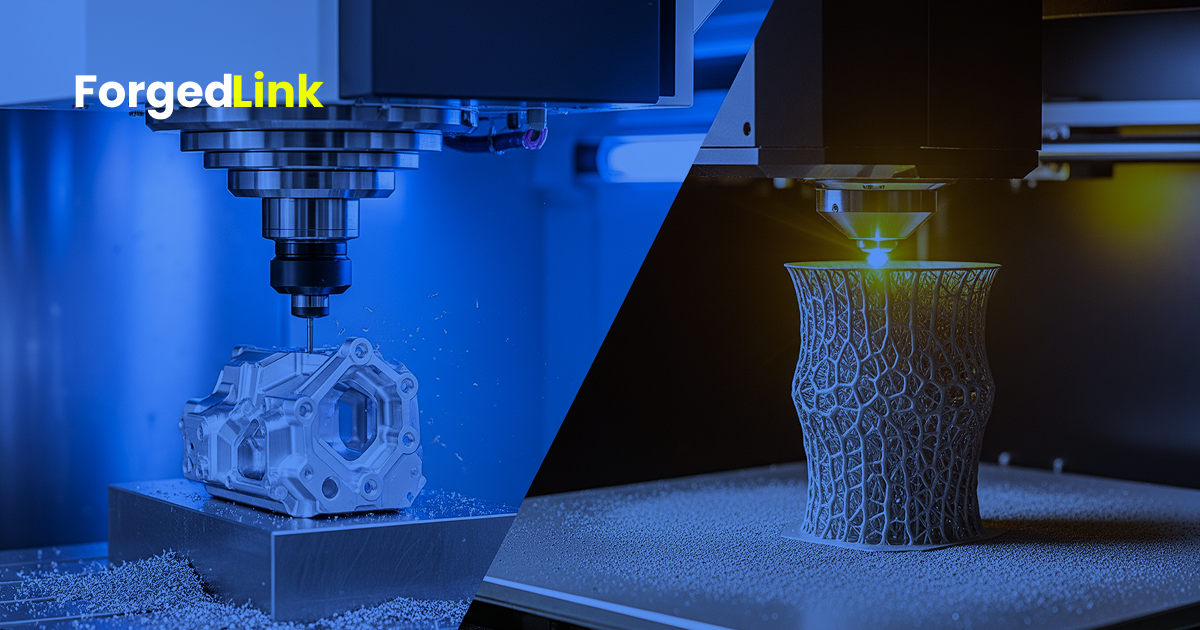
Modern manufacturing offers engineers multiple ways to produce metal components. Two of the most widely used processes are CNC machining and metal additive manufacturing, often referred to as metal 3D printing.
Both technologies are capable of producing high-performance parts used in aerospace, automotive, medical devices, and industrial equipment. However, the two methods operate in fundamentally different ways and are suited to different types of designs.
Understanding the strengths and limitations of each process helps engineers choose the most efficient manufacturing strategy for their components.
How CNC Machining Works
CNC machining is a subtractive manufacturing process. Material is removed from a solid block using computer-controlled cutting tools to create the final geometry.
This approach allows extremely high precision and excellent surface quality.
Common CNC machining operations include:
- Milling
- Turning
- Drilling
- Tapping
CNC machining is widely used for producing metal components from materials such as aluminium, steel, titanium, and brass.
How Metal 3D Printing Works
Metal additive manufacturing builds parts layer by layer using metal powder and a high-energy laser or electron beam.
Processes such as selective laser melting (SLM) or direct metal laser sintering (DMLS) fuse fine layers of powder together to form a solid component.
This method allows engineers to produce highly complex internal geometries that would be impossible to machine using traditional tools.
Cost Comparison
The cost structure of CNC machining and metal 3D printing differs significantly.
CNC machining costs are typically influenced by:
- Material cost
- Machining time
- Tooling wear
- Setup complexity
For simple parts with accessible geometry, CNC machining is often the most economical option.
Metal 3D printing costs depend on factors such as:
- Build time
- Powder material cost
- Support structures
- Post-processing requirements
While additive manufacturing may be more expensive per part, it can reduce costs when complex geometry eliminates the need for assemblies or multiple components.
Design Freedom
One of the biggest differences between the two processes is design flexibility.
CNC machining requires cutting tools to physically reach the surfaces being machined. This creates limitations for deep cavities, internal channels, and enclosed geometries.
Metal 3D printing, on the other hand, builds parts layer by layer. This allows designers to create shapes that would be impossible with traditional manufacturing.
Examples of additive manufacturing advantages include:
- Internal cooling channels
- Lightweight lattice structures
- Topology-optimised geometries
- Integrated multi-function parts
These capabilities can significantly reduce weight and improve performance in advanced engineering applications.
Surface Quality and Accuracy
CNC machining generally produces superior surface finishes and tighter tolerances compared with metal additive manufacturing.
Machined surfaces are smooth and dimensionally precise, often requiring minimal post-processing.
Metal 3D printed parts typically require additional finishing operations such as:
- Machining critical surfaces
- Heat treatment
- Support removal
- Surface polishing
For components requiring very tight tolerances or smooth surface finishes, CNC machining often remains the preferred solution.
Production Volume
The number of parts required also influences the process choice.
CNC machining scales efficiently for low-to-medium production volumes. Once machining programs are established, parts can be produced quickly and consistently.
Metal 3D printing is particularly valuable for:
- Prototypes
- Complex low-volume parts
- Highly customised components
For large production quantities, traditional manufacturing methods often remain more cost-effective.
When to Choose CNC Machining
CNC machining is typically the best option when:
- Parts require tight tolerances
- Surface finish is critical
- Geometry is relatively simple
- Material properties must remain fully consistent
This makes CNC machining ideal for many structural components and precision mechanical parts.
When to Choose Metal 3D Printing
Metal additive manufacturing becomes advantageous when:
- Parts include complex internal geometry
- Weight reduction is important
- Multiple components can be consolidated into one
- Low-volume production is required
These advantages have made additive manufacturing increasingly popular in aerospace and advanced engineering sectors.
Combining Both Processes
In many modern manufacturing workflows, CNC machining and additive manufacturing are not competitors but complementary technologies.
For example, a metal 3D printed component may include complex internal structures while critical surfaces are finished using CNC machining.
This hybrid approach combines the design freedom of additive manufacturing with the precision of machining.
Conclusion
CNC machining and metal 3D printing each play an important role in modern manufacturing. While CNC machining offers superior precision and surface quality, additive manufacturing provides unmatched design flexibility for complex geometries.
The best process depends on the design requirements, production volume, material properties, and cost considerations.
By evaluating these factors early in the design phase, engineers can select the manufacturing approach that delivers the best balance of performance and efficiency.
CTA: Compare manufacturing processes before sourcing suppliers for your part.