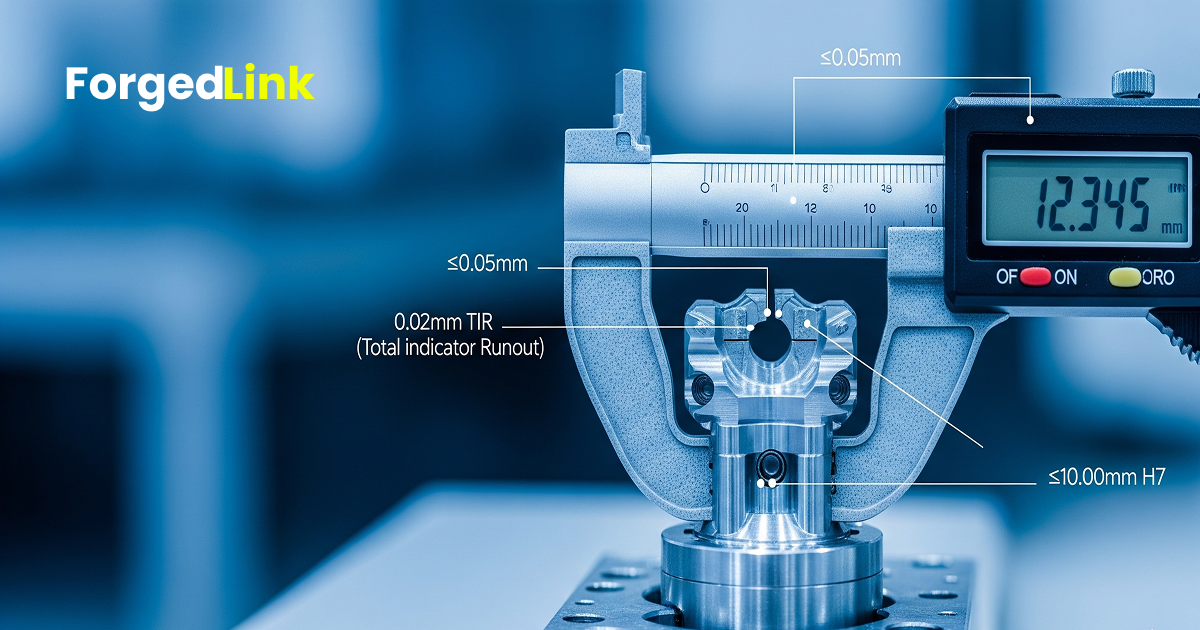
Tolerances are one of the most important yet misunderstood elements of manufacturing design. They define how much variation from the nominal dimension is acceptable in a manufactured part.
While precise tolerances may seem desirable, specifying tighter tolerances than necessary often increases machining complexity, production time, and overall cost.
Understanding how tolerances work—and when they are actually required—helps engineers design parts that are both functional and manufacturable.
What Are Machining Tolerances?
A tolerance specifies the acceptable range of dimensional variation for a feature. Instead of requiring an exact dimension, a tolerance allows small deviations that still maintain the part’s functionality.
For example, a dimension specified as:
- 20 mm ±0.1 mm
means the feature can measure anywhere between 19.9 mm and 20.1 mm and still be considered acceptable.
These small ranges are necessary because no manufacturing process can produce perfectly identical parts every time.
Standard CNC Machining Tolerances
Most CNC machining operations can achieve relatively tight tolerances compared to other manufacturing processes.
Typical general machining tolerances are:
- ±0.1 mm for standard machining
- ±0.05 mm for precision machining
- ±0.01 mm or tighter for high-precision components
The achievable tolerance depends on several factors including machine capability, material behaviour, part geometry, and tool wear.
Why Over-Specifying Tolerances Increases Cost
Tighter tolerances require slower machining speeds, additional quality checks, and sometimes specialised tooling.
This increases manufacturing time and cost.
Common impacts of unnecessarily tight tolerances include:
- Longer machining cycles
- More frequent tool changes
- Additional inspection procedures
- Higher scrap rates
- Increased overall production cost
For many parts, only a small number of features actually require tight tolerances.
Where Tight Tolerances Are Necessary
While excessive tolerances should be avoided, certain features genuinely require high precision.
Examples include:
- Bearing interfaces
- Sealing surfaces
- Press-fit components
- Alignment features
- Critical moving assemblies
For these features, precise tolerances ensure proper mechanical performance.
Designing Parts With Manufacturable Tolerances
Good tolerance design focuses precision only where it is required.
Engineers should consider:
- Specifying tight tolerances only for critical interfaces
- Using general tolerances for non-critical features
- Considering manufacturing process capability
- Avoiding unnecessary geometric complexity
This approach improves manufacturability while maintaining part functionality.
Next Step: Before sending your design to suppliers, validate whether your specified tolerances are realistic for the intended manufacturing process.